
· fatherhood · bonding · brain science
How Long Does It Take for a Dad to Bond With His Baby?
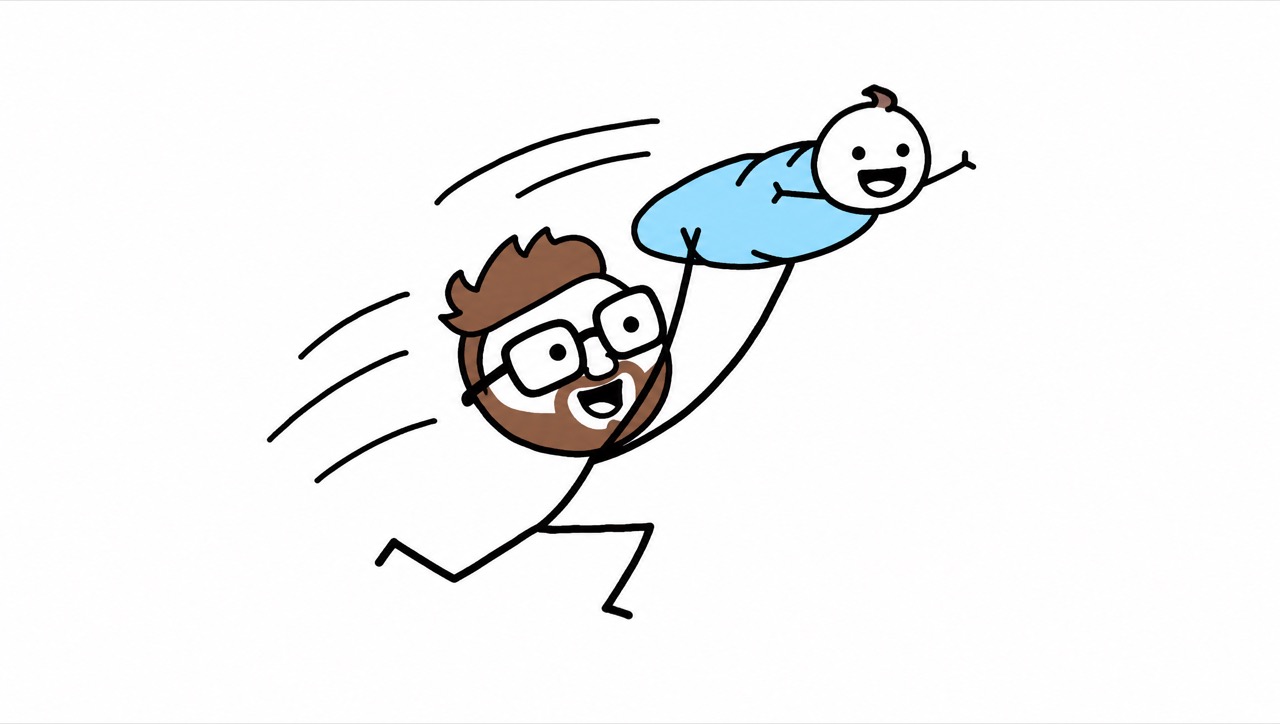
If you’re searching this question at 3am with a crying newborn in your arms, let me answer it plainly before the science: for many fathers it takes weeks to months, it builds instead of striking, and that is the normal shape of it. I’ve been exactly where you are, and nobody had told me either.
The honest timeline
Researchers who interview new fathers keep finding the same pattern. In a 2023 study of 30 first-time fathers (Journal of Reproductive and Infant Psychology), the bond was described as constructed gradually through caregiving, strengthening sharply once the baby began responding — the first real eye contact, the first smile aimed at you. Before that, you’re pouring love into what feels like a one-way pipe.
At the far end, a synthesis of 19 studies of fathers of premature babies (Alnuaimi and Tluczek, 2022) described bonding as a staged process unfolding over as long as 18 months, with many fathers starting from feeling “alien” toward their own child. Those men went on to bond deeply. A slow start is a first chapter, not a verdict.
Why it’s slower for fathers — and why that’s not a defect
A mother gets nine months of hormonal preparation before day one. A father starts at zero. But — and this is the part that fixed me — that doesn’t mean fathers get less bonding chemistry.
In a study of 160 new mothers and fathers (Gordon, Feldman and colleagues, 2010, Biological Psychiatry), fathers’ oxytocin levels were just as high as mothers’. Same fuel, same tank. The difference is the tap. Mothers’ oxytocin rose with affectionate contact — cuddling, the gentle voice. Fathers’ rose with stimulatory play: lifting, tickling, the silly physical stuff.
Her bond is switched on by gestation. Yours is switched on by contact. On day one you simply haven’t done any of it yet.
The brain evidence: it’s waiting for the hours
The most striking study in this field scanned 89 first-time parents, including 48 gay fathers raising babies with no mother in the picture (Abraham, Feldman and colleagues, 2014, PNAS). In primary-caregiving fathers, the deep emotional-alarm circuitry that fires in every new mother was active at the same level — produced by caregiving alone, no pregnancy required.
And the detail I love most: across all the fathers scanned, the more hours a man spent caring for his baby, the stronger that circuitry had become. The dad brain isn’t missing. It’s waiting for the hours. (One honest caveat: this is one influential study measuring brain activity, and the hours link is correlational.)
How to speed it up
Everything that works is a version of the same thing — get your hands on your kid:
- Skin-to-skin. A review of 12 studies (Shorey and colleagues, 2016, Midwifery) found father-infant skin-to-skin lowers fathers’ stress and strengthens their sense of the role. Shirt off, baby on chest, no technique required.
- Play, physically. It’s your oxytocin tap. The airplane game is not messing about; it’s the mechanism.
- Own a repeatable job. Bath time, the morning walk, the settle after a feed. Competence grows through repetition — and repetition is hours.
- Take the leave, all of it. Fathers who take leave stay more engaged years later (Petts and Knoester, 2018).
And if it still feels like a stranger
That’s what I felt, and I thought it made me a monster. It didn’t — it made me a father whose bond was still under construction, which is the only way fathers’ bonds ever get built. More on that specific loneliness in the loud little stranger and the day I became a father.
One thing worth separating: a slow bond is normal, but a persistent fog, rage or numbness lasting more than two weeks is something else with its own name and treatment.
Mine came. It’s enormous now. Keep showing up — the hours are the bond.
Watch the video version: I Became a Dad and Felt Lost. Here’s Why. — the same story, told out loud, in crayon.
I take apart one big question like this every week, honestly and in crayon — subscribe on YouTube and the next one will find you.