
· fatherhood · bonding · psychology
The Loud Little Stranger: What No One Tells You About the First Weeks
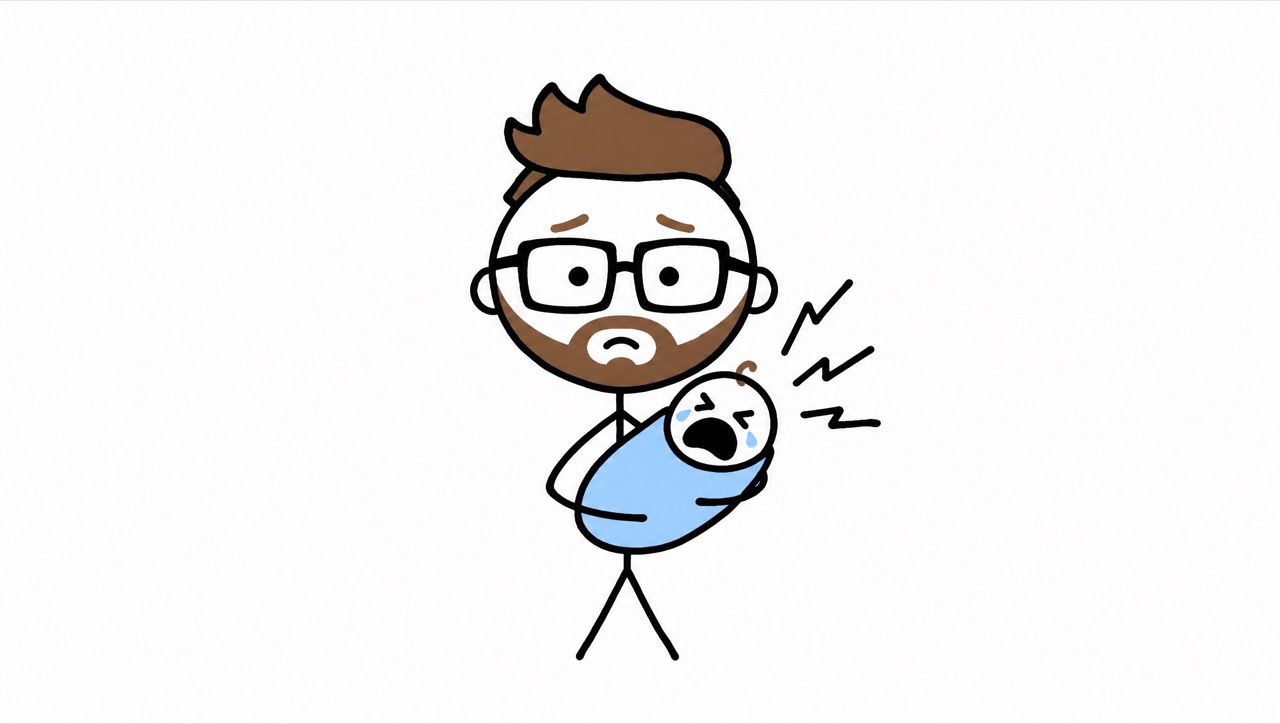
There’s a confession men only make two beers deep, and even then only to other fathers: in the first days, I didn’t feel the love yet.
I know why nobody says it sober. Because if you say “it was brutally hard and the overwhelming love arrived late,” people might quietly decide you’re a bad father. So each generation of dads walks into the delivery room expecting the movie moment — and a lot of them meet, instead, a very loud little stranger. Wonderful, terrifying, and for now, unfamiliar.
Here’s the expectation-versus-reality table that lived in my head those first weeks:
| The expectation | The reality | What it made me feel |
|---|---|---|
| Instant, magical bond | A bond that builds over months; early on, caring for a tiny stranger | Guilt — is something wrong with me? |
| Knowing how to protect and provide | Fumbling the basics of feeding, soothing, changing | Inadequacy — I’m failing already |
| Being the strong partner, 24/7 | Exhausted, touch-starved, missing how we used to be | Isolation — I’m alone in this |
Every row of that table, it turns out, is documented. And none of it predicts what kind of father you become.
What the research actually says about the timeline
When researchers interviewed 30 first-time fathers about bonding (2023, Journal of Reproductive and Infant Psychology), the picture was consistent: the bond is constructed gradually through caregiving, and it strengthens noticeably once the baby starts responding — the first eye contact, the first smile aimed at you. Before that, you’re pouring love into what feels like a one-way pipe. That’s not coldness. That’s the normal shape of the curve.
At the far end of the spectrum, a synthesis of 19 studies of fathers of premature babies (Alnuaimi and Tluczek, 2022) described bonding as a staged process unfolding over as long as 18 months — with many fathers starting from feeling “alien” toward the baby. These men went on to bond deeply. The slow start wasn’t the verdict. It was the first chapter.
And remember the biology from the post about the day my son was born: a father’s bonding chemistry is switched on by contact and play, not by pregnancy. There’s even a study I can’t stop thinking about — Weisman, Zagoory-Sharon and Feldman, 2012, in Biological Psychiatry — where researchers gave fathers a dose of oxytocin before playing with their five-month-olds, and the babies’ own oxytocin rose in response, though the babies received nothing. Connection between a dad and his child is literally chemically contagious, in both directions. But somebody has to start the loop — and in the early weeks, that somebody is you, running on faith.
The guilt is the expectation’s fault, not yours
The guilt in that table has one source: the myth of the instant bond. Drop the myth and the guilt has nothing to stand on.
What I’d say to a man in week two, holding a crying stranger at 3 a.m., feeling nothing but panic and duty: duty is the bond, at this stage. The feeling follows the doing — the science keeps finding it in exactly that order. You don’t fake it till you make it. You care for them until it becomes love. Nobody warns you because the men who lived it were too ashamed to leave notes.
So consider this the note.
Watch the video version: I Became a Dad and Felt Lost. Here’s Why. — the same story, told out loud, in crayon.
I take apart one big question like this every week, honestly and in crayon — subscribe on YouTube and the next one will find you.