
· fatherhood · mental health · psychology
Roughly One in Ten New Dads Struggle — Here Are the Numbers Nobody Mentions
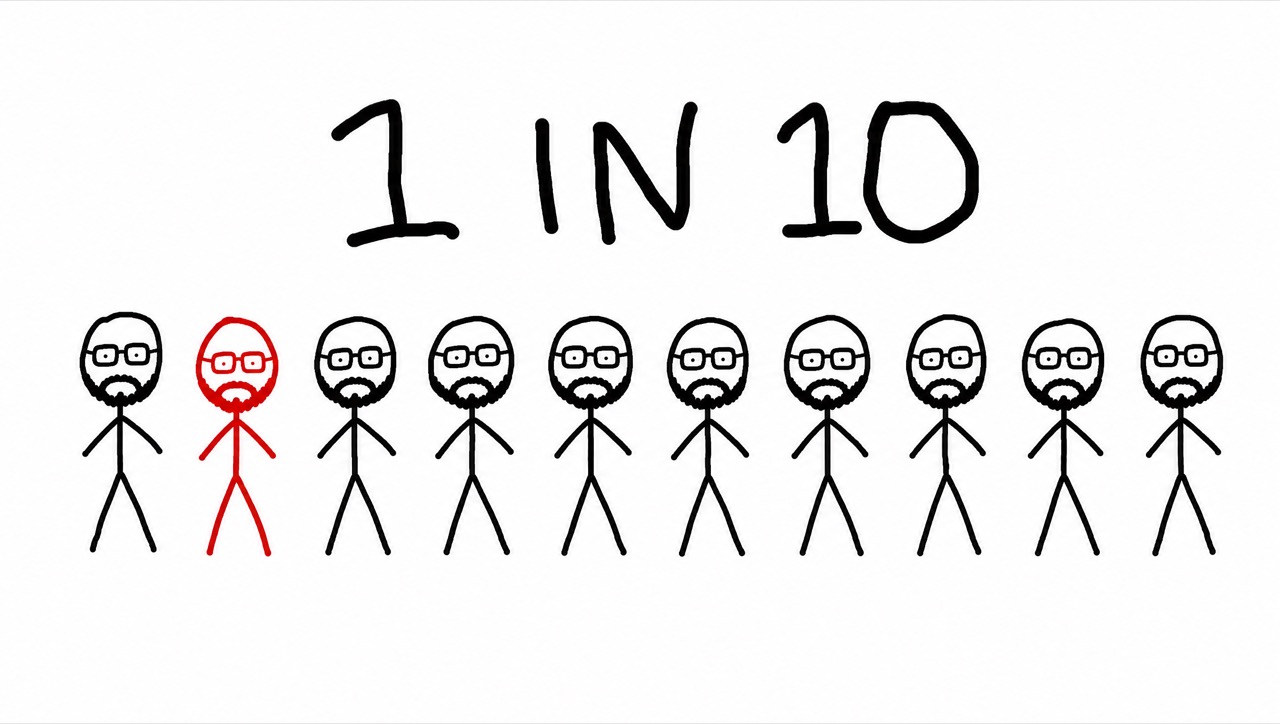
It felt like postpartum depression hit me hard — and I wasn’t the one who gave birth. For a long time I didn’t say that sentence out loud, because it sounded like stealing my wife’s thunder. She did the heavy lifting. She deserved every bit of the attention. Both things were true at once: she’d earned the world’s care, and I was quietly going under.
Then I found out my experience had a name, a literature, and a number.
The numbers, honestly reported
The landmark study is Paulson and Bazemore, 2010, in JAMA — a meta-analysis of 43 studies covering 28,004 parents. Between the first trimester and the baby’s first birthday, 10.4 percent of fathers showed depression on screening measures. For comparison, the ordinary 12-month rate in men is around 5 percent. Becoming a father roughly doubles it.
Two newer meta-analyses land close by: Cameron and colleagues, 2016 found 8.4 percent across some 74 studies, and Rao and colleagues, 2020 found 8.75 percent across the postpartum year. So the honest phrasing is: roughly one in ten new fathers, measured by screening questionnaires rather than formal diagnoses. One caveat worth knowing: these are self-report screens, and a published letter in JAMA criticized how much the early estimates varied between studies. The signal is real; the decimal points are soft.
And depression isn’t the only guest. A systematic review of paternal anxiety (Leach and colleagues, 2016) found rates of 4–16 percent before the birth and 2–18 percent after — often higher than the depression numbers, and even less talked about.
The timing question — where the science argues
Paulson and Bazemore found something that matched my experience uncannily: the worst window wasn’t the newborn blur. Rates were lowest in the first three months (7.7 percent) and peaked at 25.6 percent between months three and six — exactly when the visitors stop coming, the leave runs out, and everyone stops asking how you are.
But I have to be straight with you, because that’s the deal on this site: the bigger 2020 meta-analysis found a much flatter curve — around 8 to 9 percent in every window, no dramatic peak. So treat the “3-to-6-month spike” as one major study’s finding, not settled science. What nobody disputes is that the struggle doesn’t end when the newborn phase does.
The finding that explains so many households
Here’s the number I’d put on a billboard. Across studies, paternal depression correlates moderately with maternal depression (r = .308 in the JAMA meta-analysis). A struggling partner is the single strongest known risk flag for a struggling father.
Think about what that means practically. In the exact houses where the mother is going under, the father — the person everyone assumes is holding the rope — is most likely to be going under too. Two drowning people, each pretending to be the lifeguard. Nobody checks on the lifeguard.
What I want you to take from this
One technical note, for accuracy: “paternal postpartum depression” isn’t a formal diagnostic category — researchers call it paternal perinatal depression, and it’s measured, studied, and treatable regardless of what the manual calls it.
If the first year knocked you somewhere dark, you’re not weak and you’re not rare — you’re one in ten. It shows up differently in men, which is why it gets missed; I’ve written about why men’s version so often looks like anger instead of sadness. None of this is medical advice — but if the low mood, the rage, or the numbness has stuck around for more than a couple of weeks, talking to a professional is not an admission of failure. It’s maintenance. And if you ever have thoughts of harming yourself or anyone else, treat it as the emergency it is and contact a crisis line or emergency services now.
Watch the video version: I Became a Dad and Felt Lost. Here’s Why. — the same story, told out loud, in crayon.
I take apart one big question like this every week, honestly and in crayon — subscribe on YouTube and the next one will find you.