
· fatherhood · hormones · your body
Does Testosterone Really Drop When You Become a Father?
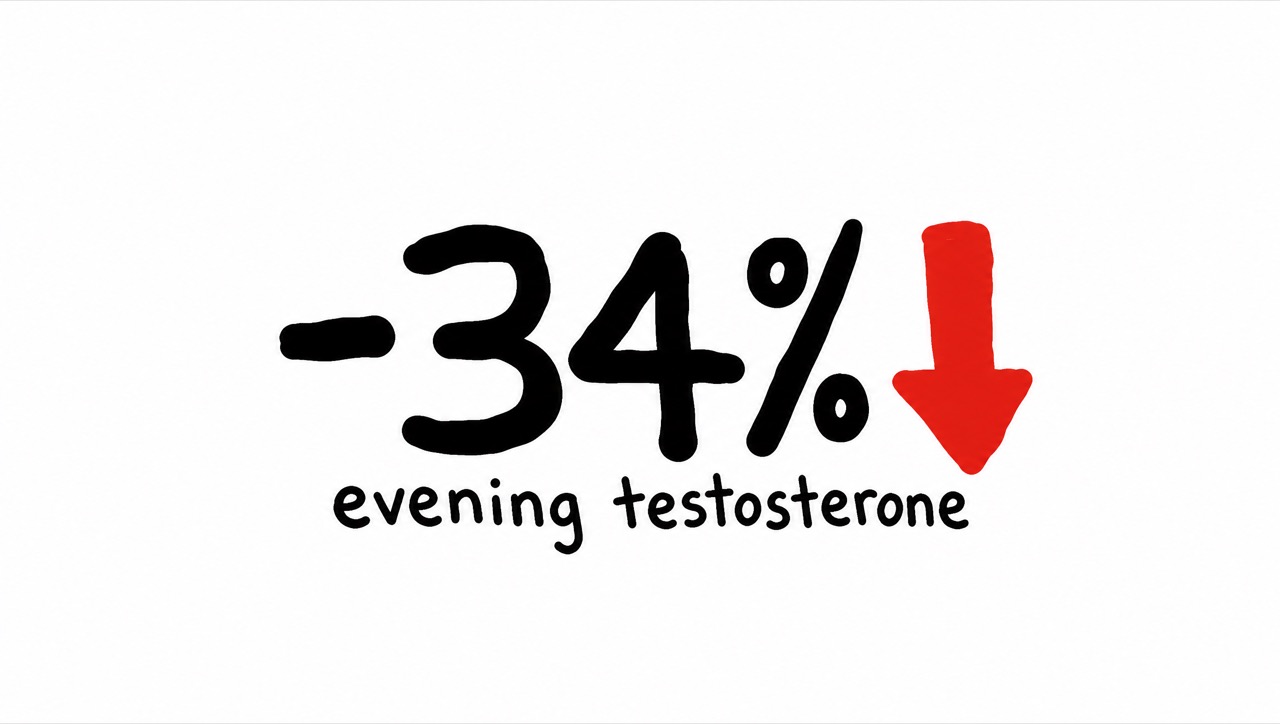
Short answer: yes, and it’s one of the better-documented findings in the biology of fatherhood. In the largest study to date, new hands-on fathers’ evening testosterone fell by a median of about a third. Here’s the actual data, the honest caveats, and the reason your body does it on purpose.
The study everyone cites
Gettler, McDade, Feranil and Kuzawa, 2011, in PNAS followed 624 young men in the Philippines for four and a half years — all single and childless at the start. The men who became partnered fathers showed:
- −26 percent median decline in morning testosterone
- −34 percent median decline in evening testosterone
- versus roughly −12 to −14 percent in men who stayed single, which is ordinary aging
Two details make this study unusually convincing. First, the men with the highest testosterone were the most likely to become fathers — then dropped the most. So it isn’t that low-testosterone men drift into fatherhood; fatherhood does it to you. Second, the drop tracked the caregiving: fathers doing three or more hours of childcare a day had lower testosterone than fathers doing none. And fathers of newborns under one month old dropped the most of all.
There’s even evidence the change starts before the birth — one small study of expectant couples (Edelstein and colleagues, 2015) found men’s testosterone already declining during their partner’s pregnancy.
The honest caveat
Later meta-analyses (Grebe and colleagues, 2019; Meijer and colleagues, 2019) confirm the direction across dozens of studies but find the average effect smaller than the Cebu numbers, with signs that early findings were inflated by selective reporting. So: the drop is real and replicated; the exact size varies by man and by study. Anyone quoting “a third” as universal is overselling one cohort’s evening figure.
Why would a body do that to itself?
Because it’s a trade, and a rare one. Direct paternal care exists in only about 5 to 10 percent of mammal species (West and Capellini, 2016, Nature Communications). Chimpanzee and gorilla fathers — our closest relatives — do essentially no direct infant care. Human dads are the biological anomaly.
High testosterone is built for competing: chasing, fighting, finding a partner. A human baby is the most helpless creature in nature, helpless for years, too much work for any one person — which is why scientists who study our evolution think human children were always raised by a team. So when the baby arrives, the body turns the competition dial down, on purpose, to make room for patience, softness and bonding.
What it feels like from the inside
Fatigue that sleep doesn’t explain. Flat days. A drive that’s gone quiet. I spent weeks reading those symptoms as personal failure. They were a redesign in progress.
And it isn’t only subtraction. While testosterone falls, oxytocin rises to match mothers’ levels in involved fathers (Gordon and colleagues, 2010) — triggered by play and contact, which is why the bond builds instead of arriving. Less fight, more hold. Your brain gets physically reorganized too.
Two things worth knowing
Should you “fix” it? Nothing here is medical advice, but note what the data implies: the decline is dose-dependent on caregiving — it’s a feature of doing the job, not a disease. If you have genuine symptoms that worry you, that’s a conversation with a doctor, not a supplement ad.
Don’t confuse it with the other thing. Low mood in the first year is common enough to have its own literature — roughly one in ten new fathers — and hormonal change is associated with it, not proven to cause it. If a fog lasts more than two weeks, talk to a professional.
Watch the video version: I Became a Dad and Felt Lost. Here’s Why. — the same story, told out loud, in crayon.
I take apart one big question like this every week, honestly and in crayon — subscribe on YouTube and the next one will find you.