
· fatherhood · your body · hormones
Your Body Knows You're a Dad Before You Do
Men don’t give birth. I was very aware of this fact while my wife did all the actual work. So imagine my surprise when I learned that my body had been quietly running its own transformation the whole time — one nobody warned me about, because apparently dads don’t tell each other anything.
Fatigue that sleep didn’t explain. Mood swings. A strange softening of the old drive. I thought I was just tired. My hormones had other plans.
The study that followed 624 men into fatherhood
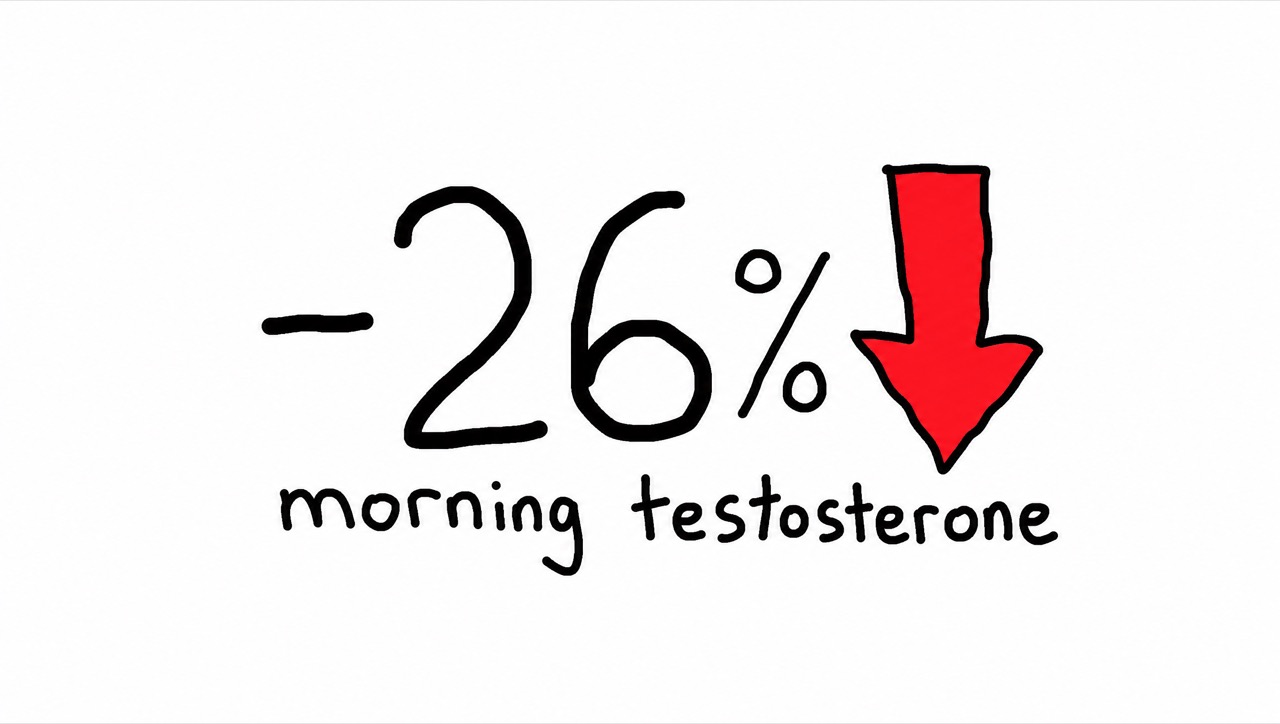
The cleanest evidence comes from the Philippines. Gettler, McDade, Feranil and Kuzawa, 2011, in PNAS tracked 624 young men over four and a half years — all single, all childless at the start. Some became partnered fathers along the way. Their testosterone didn’t just dip with age like everyone else’s. It fell off a shelf: a median drop of 26 percent in morning levels and 34 percent in evening levels — roughly a third.
Two details make this study special. First, the men with the highest testosterone were the most likely to become fathers in the first place — then dropped the most. So it’s not that low-testosterone men drift into fatherhood. Fatherhood does it to you.
Second, and this is my favorite finding in the whole field: the drop tracked the caregiving. Fathers doing three or more hours of childcare a day had lower testosterone than fathers doing none. Your body doesn’t respond to the birth certificate. It responds to the nappies.
Honesty checkpoint, as always: later meta-analyses (Grebe and colleagues, 2019; Meijer and colleagues, 2019) confirm the direction across dozens of studies but find the average effect smaller than the Cebu numbers — early findings in this field were probably inflated. The drop is real. The exact size varies man to man.
There’s even evidence the change starts before the baby arrives: one small study of expectant couples (Edelstein and colleagues, 2015) found men’s testosterone already declining during their partner’s pregnancy. Your body starts rehearsing before opening night.
Why would evolution do this to us?
Because it’s a trade, and it’s a spectacularly rare one.
Direct fatherly care exists in only about 5 to 10 percent of mammal species (West and Capellini, 2016, in Nature Communications). Chimpanzee and gorilla fathers — our closest relatives — do essentially no direct infant care (Fernandez-Duque and colleagues, 2009, Annual Review of Anthropology). Human dads are a biological anomaly. High testosterone is great for competing and finding a partner; it’s less great for patiently rocking a screaming newborn at 4 a.m. So the body reallocates — away from finding a family, toward keeping one.
And it’s not only subtraction. Those same Israeli studies I wrote about in the bonding post found fathers’ oxytocin — the bonding hormone — rising to match mothers’ levels, triggered by play and contact (Gordon and colleagues, 2010). One drops, one rises. Less fight, more hold.
When I learned all this, something in me relaxed. The tiredness, the rawness, the feeling of being rewired without my consent — my body wasn’t failing. It was doing what a few million years of unusual evolution designed it to do: turning a man into a father, chemically, whether he’s ready or not.
Watch the video version: I Became a Dad and Felt Lost. Here’s Why. — the same story, told out loud, in crayon.
I take apart one big question like this every week, honestly and in crayon — if you want the next one, subscribe on YouTube and it will find you.