
· fatherhood · relationships · psychology
Feeling Useless: The Third-Wheel Weeks Every New Dad Knows
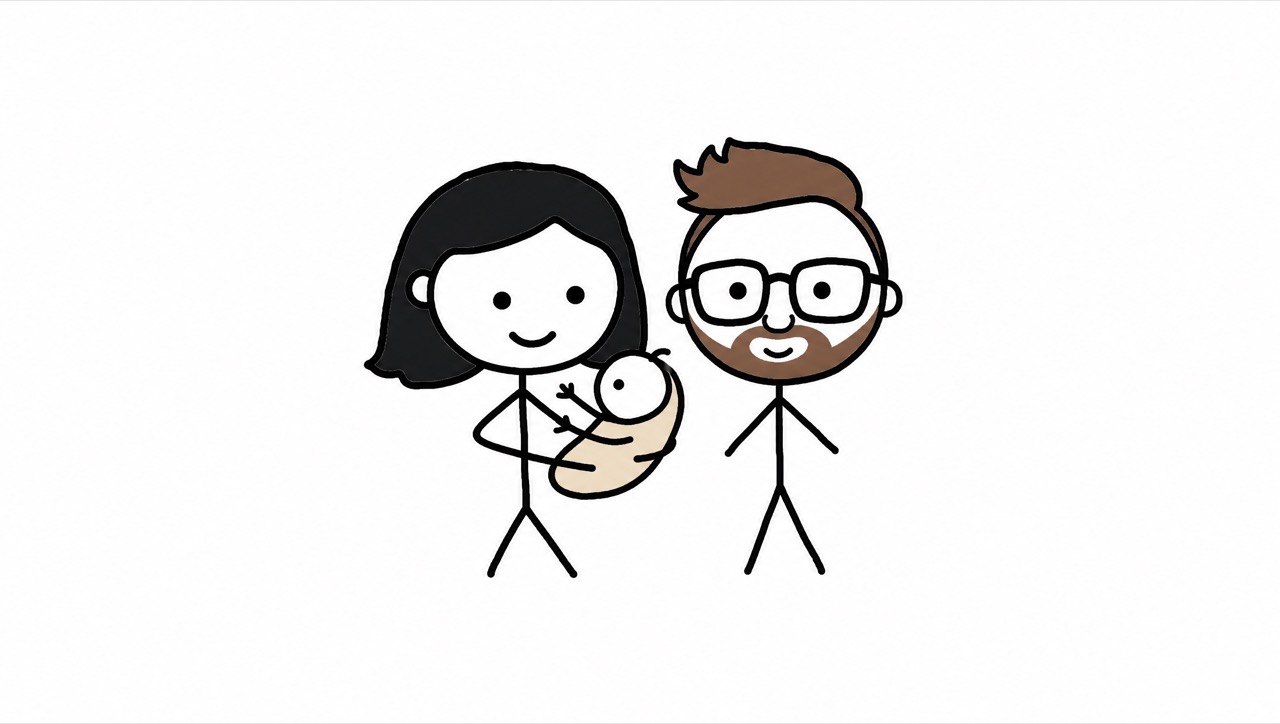
There’s a specific flavor of loneliness that comes standard with new fatherhood: being completely surrounded by your family and feeling like furniture.
The baby wanted only my wife — biologically reasonable, she was the food supply and the nine-month home. My wife was consumed by the baby. And I stood in my own kitchen like a man waiting for his job description to load. Loving them both enormously. Needed, apparently, by neither.
Researchers have heard this story so many times they named a paper after it: “I felt like a third wheel” (Cosson and Graham, 2012, Journal of Family Studies) — fathers’ own accounts of feeling excluded from the “parenting team.” A larger synthesis of 22 studies covering 351 first-time fathers (Baldwin and colleagues, 2018) found the same notes over and over: men who felt unprepared, sidelined by services built around mothers, and unsure what their role even was beyond “helping.”
The gate swings both ways
Family researchers have a name for part of this dynamic: maternal gatekeeping — the ways a mother’s beliefs and behavior can open or close the gate to a father’s involvement (Allen and Hawkins, 1999, Journal of Marriage and Family). Before this sounds like blame — the most useful finding cuts the other way. In a study of 97 families with infants (Schoppe-Sullivan and colleagues, 2008), what predicted father involvement wasn’t the absence of criticism. It was the presence of encouragement. Gate-opening mattered more than gate-closing.
Practical translation for both of you: a partner saying “you’ve got this, do it your way” builds a hands-on dad faster than a hundred corrected nappies. And dads — competence is the other key. The gate opens widest for the man who’s already reaching for the baby.
If you want one concrete, evidence-backed way in: skin-to-skin. A review of 12 studies (Shorey, He and Mörelius, 2016, Midwifery) found father-infant skin-to-skin contact benefits the baby and measurably helps fathers too — stronger sense of their role, lower stress and anxiety. Shirt off, baby on chest. It’s the lowest-tech intervention in medicine and you can’t do it wrong.
The reframe that saved those weeks for me
Here’s what I eventually understood, standing in that kitchen. In this phase, only my wife could be the baby’s whole world. But everything else in our world was up for grabs — and whoever grabbed it would decide whether she could keep pouring herself into our son without drowning.
So that became my position. I cooked — which I love anyway; I honestly think pouring your energy into a meal for someone is one of the purest ways to say I love you. I cleaned. I handled logistics. I jumped when she needed me. Not the star, not even on the field — the guy at the back of the ship, navigating, in silence. And slowly I realized the silence wasn’t a demotion. It was the job. The support crew is not a lesser role in a launch; nothing flies without it.
The sidelined feeling, the research suggests, is a phase — the baby’s circle widens, and the bond arrives through the doing. Mine did exactly that. The third wheel, it turns out, was a spare — and every vehicle that goes anywhere carries one.
Watch the video version: I Became a Dad and Felt Lost. Here’s Why. — the same story, told out loud, in crayon.
I take apart one big question like this every week, honestly and in crayon — subscribe on YouTube and the next one will find you.