
· fatherhood · mental health · men's health
The Pressure to Be the Rock — and What It Quietly Costs New Dads
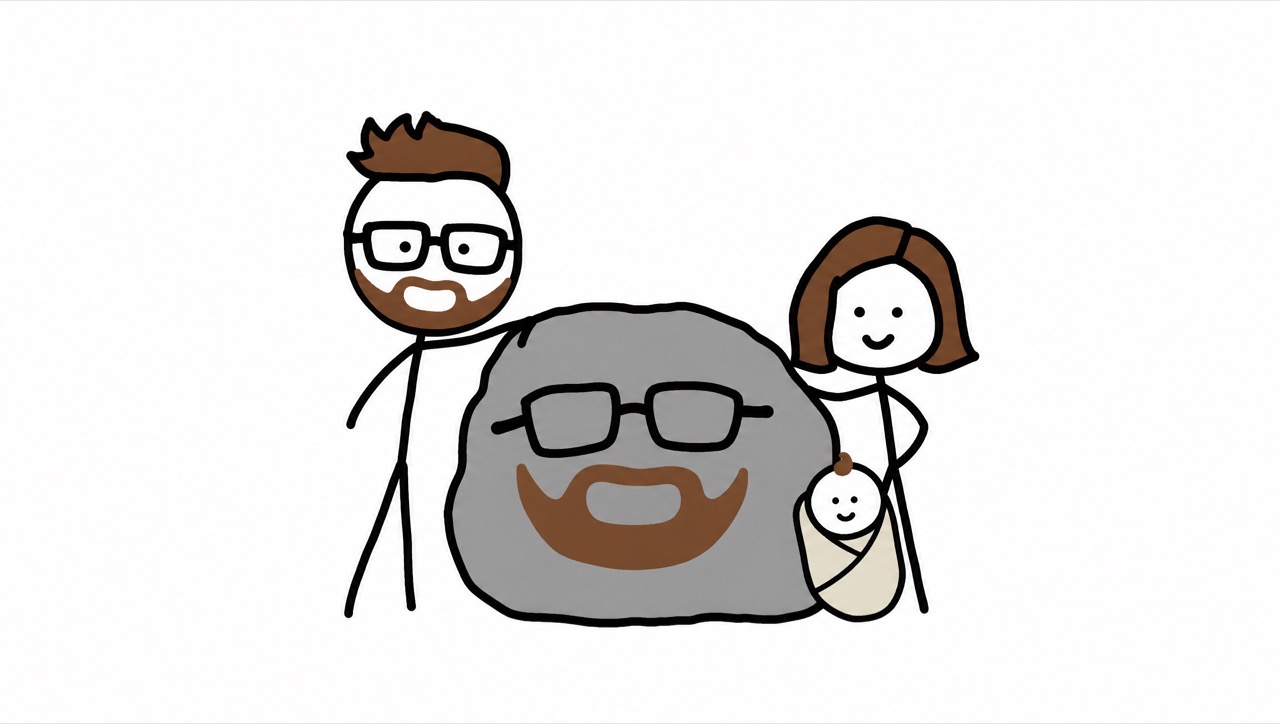
Somewhere between the positive test and the first nappy, every new father receives an unwritten job description. Nobody hands it over; you just know it. Be strong. Provide. Protect. Stay calm. Don’t complain — she’s the one who did the hard part.
I signed it without reading the fine print. And I want to talk honestly about both sides of that contract, because I lived both.
The weight, itemized
The provider pressure is its own animal. A newborn is so fragile, so entirely dependent, that even in a two-income home the math in a father’s head changes overnight: everything now rests on us — which, at 3 a.m., feels like me. When researchers synthesized 22 studies of first-time fathers (Baldwin and colleagues, 2018), this was a core theme: men suddenly carrying fears about money, safety and the future they felt they weren’t allowed to voice, because voicing them would be adding to the pile instead of carrying it.
And for me there was an extra clause, the one that arrived when I first held my son: I’m the example now. I want to raise a good man — one who respects women, loves life, helps people. Which means I don’t get to fail at being one. That thought will straighten your spine and crush it, on the same night.
What the “rock” strategy actually did for me
Here’s what surprised me: it partly worked. Having one clear mission — support my wife, because she was the only one who could feed and hold our son in those weeks — got me out of bed when nothing else would have. Purpose is a stimulant. In those months I also understood something about growing up: I couldn’t expect applause for doing my duty anymore. Some of the strength I’d been performing slowly became real.
I’m not going to pretend otherwise, because half of fatherhood culture is men pretending the rock thing didn’t work at all, and the other half pretending it cost nothing.
What it costs, measured
The bill arrives in silence. The classic research on masculinity and help-seeking (Addis and Mahalik, 2003, in American Psychologist) found that the traditional male code — self-reliance, emotional control, toughness — is one of the strongest predictors of men not seeking help for anything, including the things that are quietly ending them. In interviews with new fathers in the UK (Darwin and colleagues, 2017), men in real distress wouldn’t reach for support because they didn’t want to “detract from their partner’s needs” — the rock, refusing maintenance, on principle.
Put those together and you get the trap in its purest form: the exact strategy that carries a man through the newborn months is the strategy that keeps him from being helped when it stops working. The rock doesn’t crack loudly. It goes irritable, distant, workaholic — the male mask I unpacked in the anger post — while everyone keeps leaning on it, because leaning on it has always worked.
Rewriting the fine print
So here’s the amended contract I’d offer any new father, mine included someday:
Be strong — and know that strength includes saying, to one safe person, the unpolished sentence: “I love him, but I’m overwhelmed and scared.” That sentence doesn’t void the contract. It’s what keeps the rock from becoming rubble. The navigator at the back of the ship doesn’t stop navigating — he just refuses to pretend the storm isn’t happening.
Your family doesn’t need an invulnerable man. It needs a durable one. Those are different materials.
Watch the video version: I Became a Dad and Felt Lost. Here’s Why. — the same story, told out loud, in crayon.
I take apart one big question like this every week, honestly and in crayon — subscribe on YouTube and the next one will find you.