
· fatherhood · identity · relationships
Mourning Your Old Life Doesn't Make You a Bad Dad
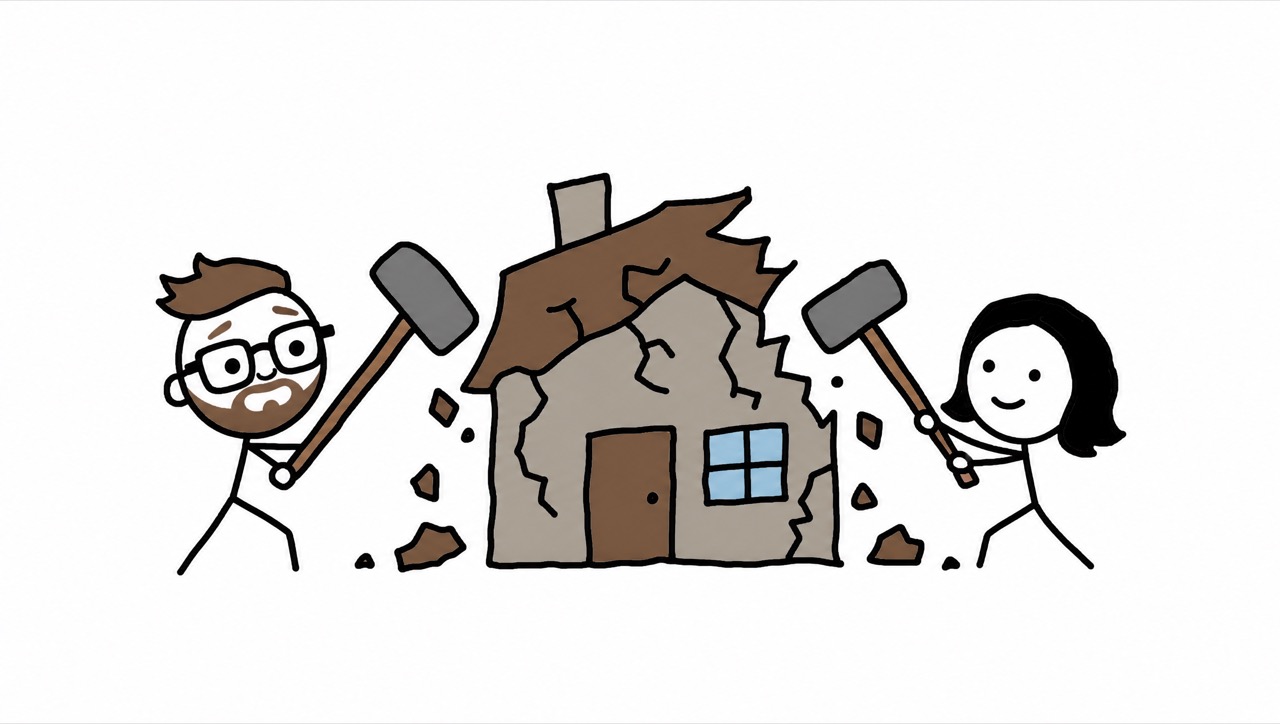
Some nights in those first months, I’d catch myself missing my old life — the spontaneity, the quiet, the version of my marriage where we could just go somewhere — and then immediately feel like a monster for missing it. I wanted this child more than anything I’d ever wanted. So what kind of man grieves the life a baby replaced?
A normal one, as it turns out. A thoroughly documented one.
The identity earthquake has a literature
When researchers pooled 22 qualitative studies of 351 first-time fathers (Baldwin and colleagues, 2018), the recurring themes read like my diary: the formation of a whole new identity, competing demands, fears they wouldn’t admit elsewhere, and a quiet mourning for independence and the old relationship. An earlier review of twenty years of research (Genesoni and Tallandini, 2009, in Birth) concluded that becoming a father is one of the most demanding reorganizations of a man’s sense of self in his adult life.
Some clinicians have started borrowing a word for this from the anthropology of motherhood: matrescence — anthropologist Dana Raphael’s term for the developmental transition into being a mother — giving us “patrescence” for the father’s version. I’ll be precise, since precision is the house style: the fatherhood term is clinical shorthand, not an established scientific construct. But the thing it points at is real and measured: you are not the same person afterward, and the demolition is part of the construction.
The marriage feels it too — here are the honest numbers
The part nobody posts on the pregnancy announcement: the relationship takes a hit. In an eight-year study of 218 couples (Doss, Rhoades, Stanley and Markman, 2009, in the Journal of Personality and Social Psychology), relationship functioning dropped suddenly after the first baby and stayed lower for years. In John Gottman’s newlywed research (Shapiro, Gottman and Carrère, 2000), two-thirds of the new mothers reported declining marital satisfaction — often misquoted as “67 percent of couples,” so let’s not — with husbands’ dip tending to follow later.
And the honest asterisk on all of it: a meta-analysis of 37 studies (Mitnick and colleagues, 2009) found the average decline is small — and childless newlyweds decline too, just gradually instead of all at once. The baby doesn’t ruin marriages. It compresses several ordinary years of change into six sleepless months.
The demolition metaphor that got me through
Here’s the thought that finally ended my guilt, and I’ve never found it in any study — this one’s mine.
I kept grieving what my wife and I had built, as if the baby had wrecked it. Then it clicked: the life we built was built for two. There was genuinely no room for a child in it — we’d designed it that way, and we’d loved it. So of course it had to come down. You don’t get to keep the old house and the new one on the same plot.
We weren’t losing what we built. We were demolishing it on purpose — to build something with three bedrooms, better foundations, and fewer of the old design mistakes. Missing the old house while you build the new one isn’t betrayal. It’s what every builder feels the day the walls come down.
Grief and love turn out to run on parallel tracks, and a new father is allowed to ride both. If the grief starts feeling less like sadness and more like anger, numbness, or going missing inside your own life, that’s worth taking seriously. But the missing itself? That’s just proof the old life was worth building — which is the best evidence the new one will be too.
Watch the video version: I Became a Dad and Felt Lost. Here’s Why. — the same story, told out loud, in crayon.
I take apart one big question like this every week, honestly and in crayon — subscribe on YouTube and the next one will find you.